MEMO: New Exit Poll – Democrats Won the Data Center Argument, Governors Show Path Forward
tags
To: Interested Parties
From: Lori Lodes, Climate Power
Date: November 10, 2026
Re: New Exit Poll – Democrats Won the Data Center Argument, Governors Show Path Forward
Data centers emerged as a lightning-rod issue in races up and down the ballot this year. The AI data center boom became the physical manifestation of voters’ frustration with rising bills and a government that put powerful companies first.
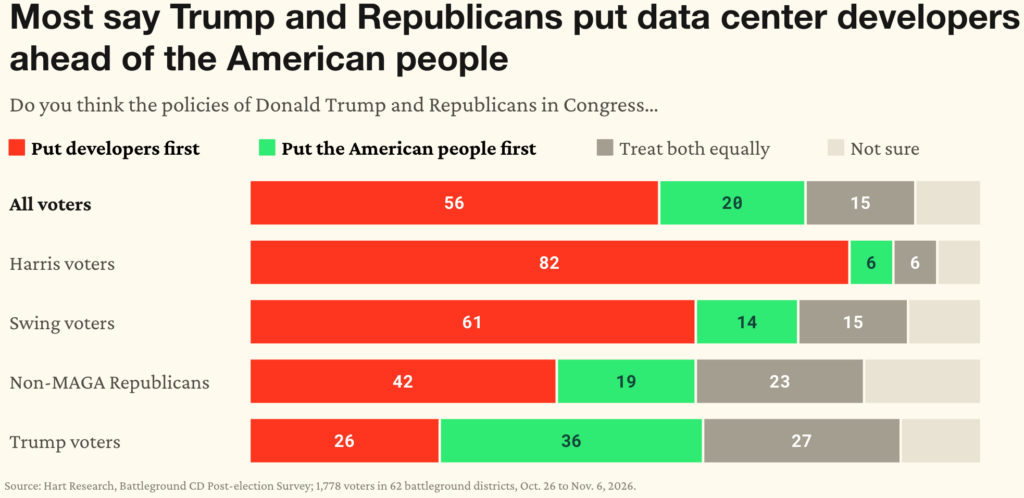
In August, neither party had a clear advantage on data centers. By Election Day, battleground voters gave Democrats a 21-point advantage on the issue, according to a new exit poll from Hart Research. The poll also found that battleground voters believed Trump and Republicans put data centers ahead of the American people by a margin of 36 points, 56% to 20%.
The political lesson is clear: voters want leaders who put families’ bills and their communities’ health ahead of tech companies’ profits. Democrats campaigned — and won — on making tech companies pay their own costs and stopping unchecked AI data center development. Now, they must lead the fight for enforceable protections, using every tool available in Congress and the states, and hold Trump and Republicans accountable when they stand in the way.
Democratic governors are showing the path forward: protect households from higher bills, require the companies driving new electricity demand to pay for new clean power and grid infrastructure, and give communities a real say. That agenda can turn public anger into a cleaner, more affordable energy system that puts families and communities ahead of tech companies’ bottom lines.
How Democrats Built a Political Advantage
AI data centers became a proxy for voters’ frustrations with rising costs and corporate favoritism. In the final weeks of the election, Democrats challenged Republicans over their support for AI data centers with no guardrails to protect families and communities:
- In at least 47 races, the Democrat spent $1 million or more on ads mentioning data centers — and in 36 of those 47 races, Democrats outspent Republicans on that same ad category by at least 3 to 1, according to AdImpact data.
- Overall, $311 million went to ads mentioning AI data centers, three-quarters of it from Democrats ($234M to $71M). The ads ran in 137 races across 42 states.
- The data center argument was part of a broader focus on household energy costs. Democratic candidates centered energy affordability in at least 40 competitive House, 10 Senate, and 13 gubernatorial campaigns across 24 states, including in 23 debates, 4,500 ads, 971+ press statements, and on the campaign trail.
Democrats held Republicans in Congress accountable for voting for Trump’s budget bill that gave $80 billion in tax breaks to Big Tech and data center developers and trying to fast-track AI data centers past environmental review and local objections in the SPEED Act. At least 12 Republicans who were called out by their Democratic opponents for their vote lost their races.
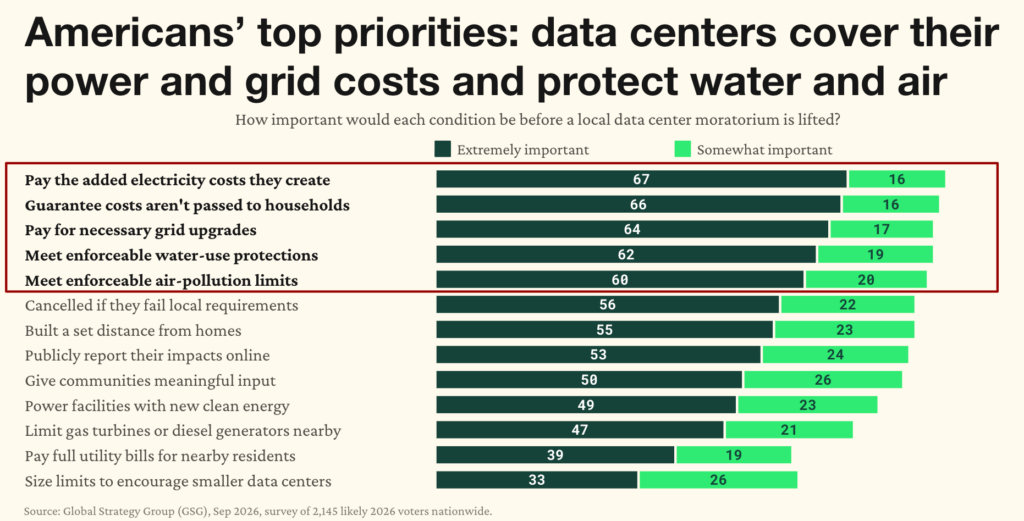
Democrats made promises people could understand. Candidates, especially governors, didn’t treat AI data centers as an abstract tech debate. They campaigned on stopping AI data centers from raising household bills, making tech companies pay their own costs, powering them with clean energy while protecting our air and water, and giving communities a say. Those commitments now provide a clear agenda for Democrats to advance in Congress and the states — and they are popular.
Climate Power identified this opening early into Trump’s second term. In 2025, we warned that clean energy supply cuts combined with AI data center demand growth would drive utility bills even higher, becoming a real political problem for Trump and Republicans. This August, after polling throughout the year, we released a memo urging Democrats to (1) go on offense, (2) embrace principles around costs, pollution, and community control, and (3) draw a sharp contrast with Trump and Republicans who put Big Tech’s profits ahead of families’ health and electric bills. Those principles provide a foundation for the governing agenda ahead.
Democratic Governors Show the Way: From Promises to Protections
As the incoming Democratic majority in Congress develops its agenda, it can draw on the work of Democratic governors who have been addressing voters’ concerns on AI data centers. Climate Power polling has found that governors are the most trusted voices on AI data centers.
A Climate Power analysis finds that at least 14 sitting Democratic governors have taken action or proposed guardrails to ensure that AI data centers use clean energy and cover their own costs. Nine newly elected Democratic governors have promised some version of the same.
Their actions and statements demonstrate how affordability, clean energy, and community protections can fit together.
Sitting Governors
- Pennsylvania Governor Josh Shapiro: “If companies want the Commonwealth’s full support, they must meet strong standards on energy affordability, clean energy generation, transparency, workforce development, community impact, and environmental protection.” In Pennsylvania, thanks to Governor Shapiro, AI data centers don’t get a permit review unless they legally commit to Shapiro’s GRID requirements, including ramping up clean firm energy sourced in-state by 2035.
- Virginia Governor Abigail Spanberger: “The Framework is a thorough plan to end AI data center secrecy, protect our environment, lower energy costs for families, bolster our clean energy economy, and make sure Virginia workers have the protections and assurances they deserve.” Data centers that invest in clean power get priority grid access under Spanberger’s new Accountability Framework. The ones that don’t will need to wait in line.
Governors-elect
- Wisconsin Governor-elect David Crowley: “If they are going to be here, they should have to pay 100% of their energy use and pay 100% of any grid or infrastructure upgrades. And they have to adopt the ‘BeYONCE’ approach, which means bring your own clean energy. They need to be investing in both solar as well as wind power to make sure they’re getting as close to 100% renewable energy as possible.”
- Nevada Governor-elect Aaron Ford: “I’ve said they’re not going to be able to raise consumer rates by one penny. They’re going to have to use clean energy, their own clean energy, to power their facilities and build out the grid to accommodate that.”
The next test is implementation: turning these commitments into requirements that companies must meet and communities can enforce.
Putting Accountability Into Practice
Democrats campaigned against special treatment for tech companies at the expense of working families. These three principles turn that contrast into an agenda they can fight for in Congress and advance in the states. Together, they define who pays for the buildout, how it gets powered, and who has a say.
Principle #1: Tech companies should pay their own way. Republicans provided billions in tax breaks for AI data centers without requiring protections to keep their growing energy demand from driving up household utility bills. Democrats should fight for enforceable rules requiring tech companies to cover the costs of the power and the grid infrastructure they need, rather than passing those costs to families. Hart’s exit poll shows that voters blame AI data centers the most for making energy prices worse (-52pp), even more than Trump (-42pp), and oil and gas companies (-50pp).
Principle #2: New AI data centers should be powered by new clean energy with strong protections for air and water. Republicans fast-tracked AI data centers past environmental review and weakened pollution protections, even making it so they do not need to follow the Clean Air Act. Democrats should push for new clean energy to power the buildout and strict safeguards for communities’ air and water to avert a new epidemic of air pollution. Hart’s exit poll points to the political opening: voters view AI data centers very negatively with a -41 disapproval rating, while giving solar energy a strong positive rating of +53 approval.
Principle #3: Communities must get a real say. Republicans repeatedly sought to block states and localities from passing their own guardrails on AI and data centers. Democrats should defend that authority, demand transparency about the costs, risks, and benefits for households and communities, and give residents a meaningful say before decisions are made. Hart’s exit poll found nearly six in ten voters think their interests take a back seat to AI data center developers and tech companies.
Previous polling from Climate Power found that a combination of these guardrails completely changes the way communities would consider an AI data center nearby:
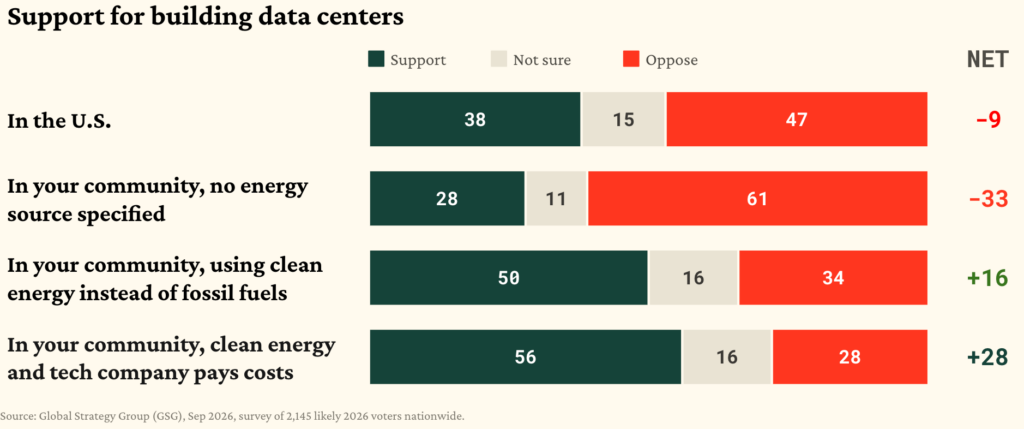
These findings point to a path for earning public support. They do not replace a community’s right to evaluate an individual project or decide that it does not meet local needs.
Congress Must Expose Any Corruption and Advance Real Protections
Congress should use oversight to establish who benefited from the Trump administration’s AI data center policies, what those decisions cost the public, and whether corporate influence shaped them. The Trump administration’s close alliance with tech companies deserves scrutiny.
Here are the facts:
- The Trump administration has fast-tracked AI data center development while exempting developers from key pollution rules.
- Trump’s Environmental Protection Agency (EPA) under Lee Zeldin has exempted AI data center power plants from Clean Air Act protections against acid rain.
- Trump’s Department of Justice (DOJ) and EPA have intervened in federal court on behalf of one of the worst polluting AI data center companies, arguing that AI’s national security implications put those facilities above the law and render community objections moot.
- Trump has pressured hyperscalers to power the buildout with gas and coal despite the unpopularity, which drove utility bills up further.
- Trump has told communities they “can’t fight” the buildout and famously demeaned any community with objections as wanting to be “backwards and poor.”
- Now the administration is planning massive giveaways of public lands for AI data centers.
Congress should use its oversight authority to focus on:
- Rising utility bills: the use of more expensive power sources, such as gas and coal, increased strain on the grid, and ratepayers having to cover the cost of building out grid infrastructure.
- Giving special treatment to developers: tax breaks, access to public land and other resources, and deals that deserve scrutiny over who benefits, who pays, and what companies have promised in return.
- Undermining pollution protections: decisions to weaken or waive environmental safeguards for clean air and clean water on behalf of AI data center developers.
- Limiting community input: efforts to limit state and local protections and/or exclude residents from having a say on data center development.
Democrats can and should use oversight to expose corporate favoritism and any corruption and build the case for enforceable protections. AI data center developers should no longer assume they can profit at unprecedented levels while households pay higher electricity bills and communities bear the pollution. Democratic leaders at every level of government must advance meaningful guardrails: tech companies pay their own way, primarily power AI data centers with clean energy, and communities have a real say.
Democratic governors have shown that these standards are attainable and popular; for example, Governor Shapiro’s actions were applauded not only by environmental stakeholders, but also by labor and industry. Congress should build on the strongest state examples to advance national standards, even as governors continue to act on their own. By 2028, leaders should be able to point to new clean power, company-funded infrastructure, and protections that families can count on.
Democrats campaigned on changing who pays and who benefits from the AI data center boom. Now they have the chance to make the companies driving it help build a cleaner, more affordable energy system. Trump and Republicans’ special treatment for data center developers became a symbol of a government that put corporate profits ahead of families’ bills. By fighting for real guardrails, Democrats can show Americans that they are on the side of the people who elected them.
For tech companies, the message is clear: earning public support means paying your own way, investing in new clean power, and respecting the communities where you build.