Trump’s Energy Crisis
Since Trump took office, household electric bills are now up 15% nationally, having previously spiked as high as 18%. Trump’s war of choice in Iran is sending oil, diesel, and jet fuel prices skyrocketing – yet his priority is spending nearly $4 billion in taxpayer dollars to stop homegrown clean energy production that would protect Americans from global oil shocks.
Donald Trump and Congressional Republicans started this energy crisis with their attacks on clean energy projects and are now accelerating it with their war of choice in Iran. These canceled projects would have produced enough electricity to power the equivalent of 21.9 million homes. Without them, utility costs have gone through the roof, factories are closing down, and we are more dependent on volatile foreign oil. These actions are also dramatically increasing the pollution of our air and water.
Learn more about Trump's Energy Crisis
THe JOBS Numbers
Updated on August 27, 2026
-
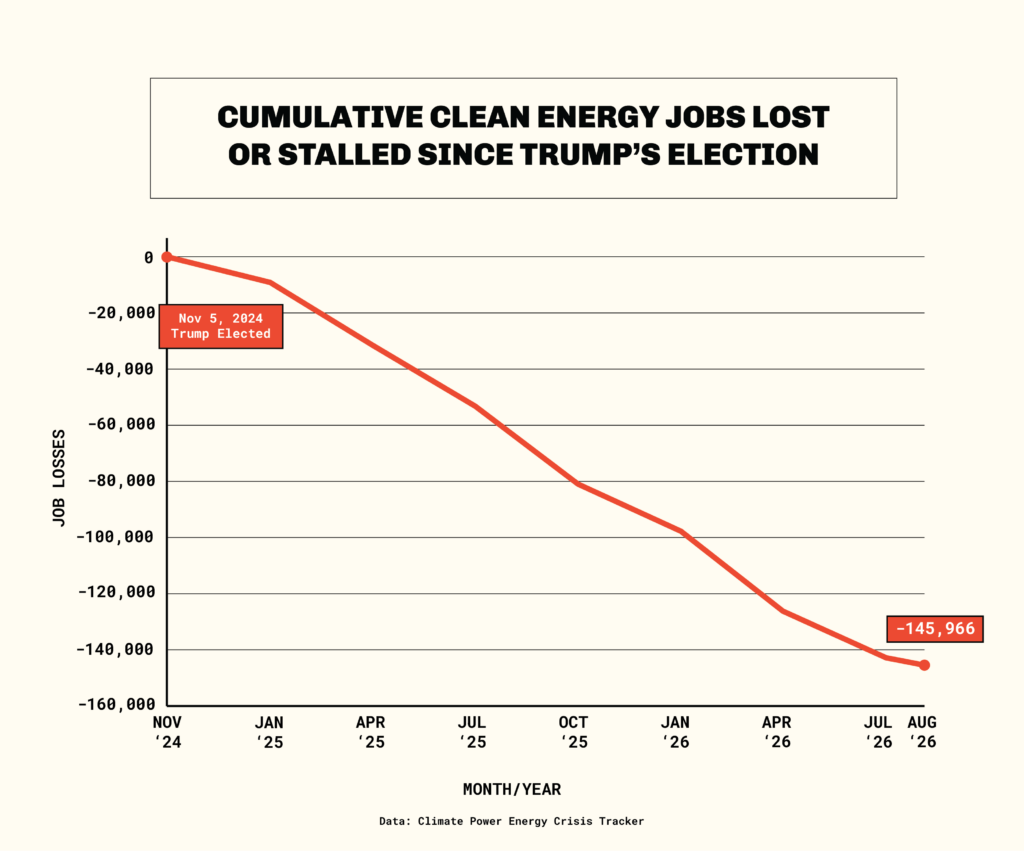
145,966
jobslost or delayed
-
$75.66
BILLIONlost or delayed private investment
-
401
PROJECTScanceled, delayed, or laying off staff
THe ENERGY Numbers
Updated on August 27, 2026
-
42,211
MEGAWATTSlost energy capacity
-
21.9
MILLIONhomes that could be powered by lost energy capacity
Energy Crisis Tracker
Source: Climate Power


10 STATES WITH THE MOST CLEAN ENERGY JOBS LOST
| State | # OF PROJECTS | JOBS LOST OR DELAYED | INVESTMENTS LOST OR DELAYED |
|---|---|---|---|
| NEW MEXICO | 4 | 17,085 | $3,363,550,000 |
| MASSACHUSETTS | 19 | 17,014 | $8,608,600,000 |
| NORTH CAROLINA | 12 | 9,935 | $2,320,500,000 |
| ARIZONA | 9 | 9,710 | $3,819,200,000 |
| NEW JERSEY | 8 | 8,519 | $3,696,000,000 |
| NEW YORK | 26 | 8,409 | $3,222,122,000 |
| MICHIGAN | 25 | 5,056 | $1,737,900,600 |
| ILLINOIS | 18 | 5,904 | $4,764,300,000 |
| OHIO | 12 | 5,765 | $1,282,900,000 |
| SOUTH CAROLINA | 8 | 5,220 | $3,600,900,000 |