POLLING MEMO: Utility Bills, Clean Energy, & Electoral Opportunity in 2026
tags
TO: Interested Parties
FROM: Hart Research and Workbench Strategy
DATE: February 19, 2026
RE: Utility Bills, Clean Energy, & Electoral Opportunity in 2026
To understand how voters view rising energy costs and how to best communicate on the issue, LCV and Climate Power commissioned qualitative (late last year) and quantitative (in January) research with Workbench and Hart.1
The Upshot:
- Utility bills have joined groceries as a top tier issue in the affordability crisis.
- There is both a need and an opportunity for Democrats to lead on energy costs; voters view clean energy as one of the few sectors actually helping to lower costs by stabilizing prices and expanding supply at a cheaper and faster rate.
- Voters strongly oppose Trump and Republicans taking affordable clean energy off the grid and believe this makes the affordability problem worse.
- Utility companies send the bills and get automatic blame; Democrats gain resonance when they show they’re willing to stand up to utilities and side with consumers.
Key points to know from this research:
1) Rising electricity bills have become a major pressure point in the broader cost-of-living crisis. Voters describe energy costs as unpredictable and raise the issue unprompted as a top household concern.
Eighty-four percent (84%) are concerned about the cost of electricity, on par with concern about the cost of housing, and only a few points below groceries and healthcare. Among swing voters, the concern is intense, with 42% VERY concerned about electricity costs. Nearly eight in 10 (78%) report that their electricity and heating bills have gone up over the past year, including 31% who say these bills have gone up a lot.
This is not isolated to high-rate areas. Concern exceeds 80% nationwide, and voters in “lower-increase” areas are just as likely to report rising bills as those in the hardest-hit regions.
2) Republicans’ ongoing failure to address high energy costs has created an opportunity for Democrats to lead the charge. Over the past year, voters have done a 180 on their view of how Donald Trump is performing when it comes to energy prices:
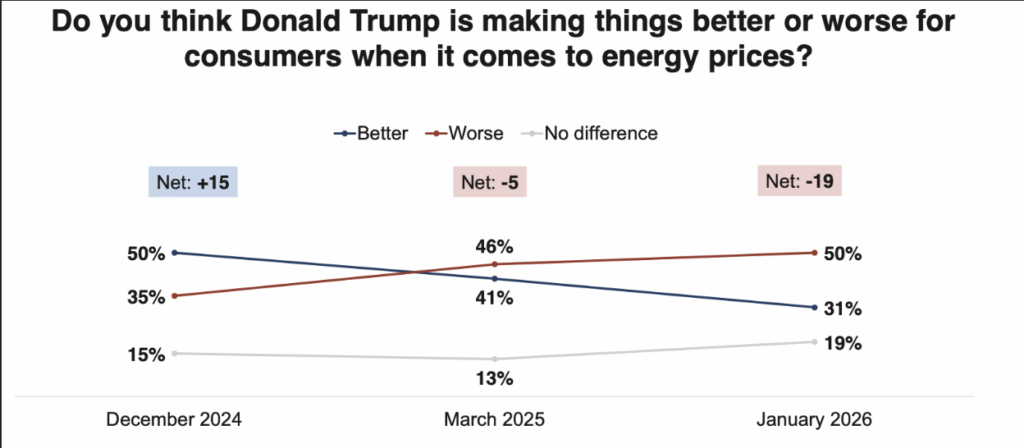
Congressional Republicans have seen a similar reversal. In December 2024, voters said Republicans were making energy prices better by four points; now voters say Republicans are making things worse by 22 points.
But Republicans’ loss is not automatically Democrats’ gain. In December 2024, voters said Democrats in Congress were making energy costs worse by 12 points; now they say worse by a 22-point margin. The rising tide of energy costs is sinking all boats, so Democrats will need to be proactive and deliberate to fill this gap, as Democratic candidates did successfully in the 2025 elections.
Right now, trust on dealing with electricity and home energy costs is essentially even: 32% trust Democrats in Congress more, 29% trust Republicans more—but 30% do not presently trust either party on this. Distrust is especially high among independent and undecided voters. The good news is that the playing field is level at the moment and the research points to clear strategies for Democrats to seize an advantage.
3) Positive messaging for Democratic candidates or the groups supporting them is strongest when we plug into a broader affordability narrative. We tested 13 statements Democratic candidates for Congress might make on energy. By far the most compelling message we tested places electricity prices squarely in the larger cost of living fight:
[GENERAL COST OF LIVING] Our number one priority is to make life affordable for people again. That means lowering the cost of housing, groceries, childcare, and electricity. We can bring down electricity bills by increasing our use of cheaper, cleaner energy.
This is the #1 message across the board, with base, turnout, and persuasion audiences.
Three subpoints, drawn from other strong-testing messages, provide support to the overarching affordability narrative:
- Democrats should hold utilities accountable for their excessive rate hikes. Utilities overcharging customers stands out as the most intuitive and immediate villain in voters’ minds, especially for less engaged voters. Voters want to see Democrats stand with them against price gouging and corporate greed.
- Solar and wind are some of the cheapest energy sources right now, and investing in them will give families more control over their bills than financing volatile oil and gas. Voters are frustrated by unpredictable bills and feel they have no control over costs. Cheaper, more stable clean energy offers the stability and peace of mind they’re looking for.
- As demand keeps increasing, clean energy is an affordable option with unlimited supply, making it a smart choice now and for the future. Voters see clean energy as one of the few bright spots in the current energy environment and a rare ally on consumer costs. A majority (52%) say using more clean energy will make electricity more affordable in the next year or two (just 20% say less affordable), and 58% say it will do so in the next 10 years.
4) To go on offense against Republican office holders, the primary message should be that energy bills have skyrocketed on Republicans’ watch while their actions have made the problem worse. Voters in the qualitative research describe Trump and Republicans as failing to deliver on their promises, especially on cost of living and energy costs. The top two messages in the survey directly tie Republicans to the 13% increase in energy bills while they have been in charge and pair it with taking affordable energy options off the grid.
| Higher energy bills for Americans coupled with canceling of clean energy projects that eliminated jobs and reduced energy supply. | [COSTS + CLEAN ENERGY JOBS] Republicans supported canceling 300 clean energy projects, including many in your state that would have helped lower energy bills. This decision killed thousands of good jobs, while Americans’ energy bills have increased 13% in the past year. |
| Failing to rein in energy bills—and in fact making them worse by getting rid of clean energy. | [PROMISES IGNORED] Republicans promised to immediately lower the cost of living if they were elected. After a year of full control in Washington, electricity bills have gone up 13%—more than four times the rate of inflation—and they’re making it worse by turning off energy if it comes from clean sources. |
Augmenting these messages with the criticism that Republicans are siding with utility companies and are failing to hold them accountable is a compelling and credible way to tie the GOP to voters’ most top-of-mind villain. Utility companies send the bills and get automatic blame. Three in four voters (75%) blame utility companies overcharging customers to increase profits for rising electricity bills, and 79% blame state utility regulators for letting utilities charge whatever they want. This frustration cuts across party lines, among older and younger voters, across SES, and in every region of the country.
A similar accountability frame with tech and AI companies is salient when tied to growing demand and communicating with younger voters.
1 Three asynchronous online discussions November 10-13, 2025, with Democrats, independents, and Republicans across 18 GOP-held battleground congressional districts. A national online survey followed January 12-18, 2026, of 2,710 registered voters, including oversamples in those same CDs and in the 15 areas of the country that saw the largest energy rate increases in 2025. Survey credibility interval is ±2.24 percentage points. Additional research will sharpen language and messaging in the coming month.